
NextGen vs Epic: Which Fits Your Practice?
As healthcare technology evolves, providers are rethinking their Electronic Health Record (EHR) strategies to improve patient engagement, efficiency, and compliance. Choosing the right EHR software is now more of a strategic decision as it directly impacts care quality and operational performance.
Among the top contenders, NextGen and Epic are two widely implemented platforms; both have their own distinct clinical environments. NextGen caters to ambulatory and specialty practices looking for intuitive workflows and flexibility, while Epic serves large hospital networks and medical centers known to have complex data-driven operations.
In this blog, we will get into an in-depth NextGen vs Epic comparison to help you decide which platform best suits your healthcare organization.
NextGen Vs Epic: At A Glance
Features | NextGen | Epic |
|---|---|---|
Best For | Small to mid-sized practices | Large hospitals and academic medical centers |
Rating | 4/5 | 4/5 |
Mobile App | iOS | iOS and Android |
Deployment | Cloud-based | Cloud-based |
Medications | ✓ | ✓ |
Patient Information | ✓ | ✓ |
SOAP Note | ✓ | ✗ |
Practice Management | ✓ | ✓ |
Custom Reports | ✓ | ✓ |
Lab Results | ✓ | ✓ |
Telehealth | ✓ | ✓ |
Value-Based Care / Remote Patient Monitoring | ✓ | ✓ |
Patient Experience | ✓ | ✓ |
Pricing | Subscription-based model with implementation and support fees | License-based enterprise pricing with implementation, maintenance, and training costs |
What Is NextGen?
NextGen EHR software is a cloud-based platform that combines EHR and practice management capabilities for ambulatory and specialty care practices. It unifies clinical documentation, patient engagement, and billing within a single interface to deliver a complete healthcare management solution.
The platform offers two EMR solutions: NextGen Office (for independent and small practices) and NextGen Enterprise (for mid-size to larger ambulatory groups). Both options include e-prescribing, revenue cycle management, and integrated telehealth.
With a focus on interoperability and ease of use, the platform enables healthcare professionals to enhance care coordination and streamline administrative workflows.
Unique Features
- Ambient Assist: Uses Artificial Intelligence (AI) to automatically transcribe and structure patient-provider conversations into detailed Subjective, Objective, Assessment, and Plan (SOAP) notes in seconds.
- Specialty-Specific Templates: The system includes templates developed for different medical specialties. These templates allow providers to enter information in formats suited to the clinical and documentation requirements of each specialty.
- NextPen: A digital pen that records handwriting on designated paper forms and transfers the data into the electronic health record. It connects paper documentation with digital records without the need for manual data entry.
What Users Have To Say
Some of NextGen EMR problems are the same ones that many EMRs have. For example, some users say that the UX is hard to use and complicated, and that upgrades are slow and can cause the system to stop working. Many reviews of this product also say that the vendor support isn’t excellent.
What Is Epic?
Epic software is a leading enterprise-level EHR platform widely used by large hospitals, medical centers, and integrated health systems. Known for its extensive functionality, it consolidates clinical, financial, and administrative operations under an ecosystem to support coordinated care delivery.
The platform provides intensive interoperability across inpatient, outpatient, and specialty modules. This allows healthcare organizations to manage patient records efficiently. With in-built analytics and population health tools, it helps providers to monitor outcomes and optimize performance.
Moreover, the platform connects multiple healthcare entities through a shared patient record, decreasing data silos and improving continuity of care.
Unique Features
- MyChart And MyChart Bedside: Allows patients to see medical information, view test results, manage appointments, and communicate securely with providers.
- Care Everywhere Network: Enables secure data exchange across Epic-powered health organizations for easy access to complete patient histories during care transitions.
- Epic App Orchard: Provides an open marketplace for third-party extensions and integrations.
What Users Have To Say
According to the users, integration and price are two things that Epic does not do well. Epic EMR does not allow its users to share information with other software systems.
Even sending data to platforms that aren’t integrated with Epic costs money. As a result, it adds to the price, which turns some people away.
Features Comparison

These EMR systems offer full and powerful features, such as charting, storing vitals and measurements, using prescription templates and ePrescribing, and more.
Medications
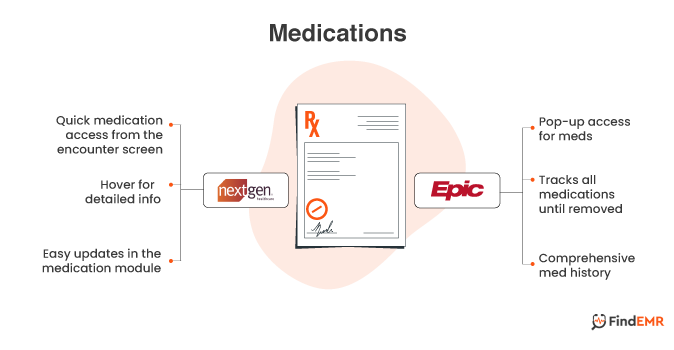
In NextGen, the patient encounter screen displays a list of medicines and the number of items on that list.
If a doctor hovers over a medication, they can see more information about it. When users click on the link, they are taken to the medication module, where they can add new entries or change the ones already there.
Epic EHR keeps track of medications on the encounter screen. The log has all medicines prescribed by Epic providers.
You can access it through a pop-up window, so you don’t have to switch between screens. It is valuable, but it keeps all your old medications until a doctor removes them.
Winner: NextGen takes the lead because of its intuitive and efficient medication management interface.
Patient Information
The dashboard of NextGen EMR lets users work more quickly and easily. They can look at past HPIs, exams, assessments, and plans without switching to another screen. It also enables them to view patients’ medical history, medications, and allergies. Users can also flip through charts with auto-grow grids in NextGen EMR.
Physicians can use the patient information bar to quickly look up information like age, date of birth, insurance company, address, etc., without stopping what they’re doing.
This solution allows users to move their mouse over fields to see more information without leaving their screen – addressing a common problem for doctors.
The patient’s primary pharmacy, rendering provider, and primary care provider can also be seen on the patient encounter screen.
Epic EMR lets users keep track of all patient information, like their medical history, medications, allergies, lab/radiology results, and more.
A pop-up window lets doctors get to this information. In addition, patients can use various mobile apps to access their medical records, encouraging them to take an active role in their care.
However, when compared to NextGen, Epic is more difficult to use and has a steeper learning curve, according to some users.
Also, if a patient’s medical history comes from a provider who isn’t part of Epic EMR, you can’t access that information through EMR integration.
Winner: It’s a tie. NextGen offers easier navigation and faster access to patient data, suitable for smaller practices. Whereas Epic provides deeper patient engagement, making it ideal for larger healthcare networks.
SOAP Notes
Users of NextGen EMR can save a whole SOAP note without losing its format, and they can use ‘Quick Note’ to use it again for common findings. With ‘Quick Saves,’ users can also save their preferences for procedures and exams.
If users leave their SOAP note or finish it, it will still be in the same format when they return. It shortens the time it takes to learn and makes it easier to use templates.
Epic EMR does not support SOAP notes as many other EMRs do. It is partly because Epic has its way of handling data, which doesn’t let it share data with other companies.
As a result, Epic EMR’s encounter record doesn’t follow the standard SOAP note format.
Winner: NextGen stands out with its Quick Note and Quick Save tools, which reduce documentation time.
Diagnosis
Using an EMR instead of paper records makes it easier to keep records. EMRs have a list of symptoms that doctors can use to figure out what’s wrong with a patient.
Standardizing signs and ICD-10 codes for those symptoms makes it easier to record and bill for care.
EMRs, EHRs, and medical practice management software should be able to do this in some way, but how easy it is to use and how much it does will vary.
NextGen EMR lets its users write diagnoses and notes about patient interactions.
Users can use PFT and standard codes like SNOMED CT and ICD-10 to find diagnoses in the list of problems.
On the encounter screen, doctors can see how many allergies, problems, medications, and diagnoses a patient has. When you move your mouse over the issues tab of the encounter screen, a list of long-term problems appears.
The diagnoses tab shows a complete list of all diagnoses made during previous encounters. The hover option makes it easy for users to find information about a patient without having to change templates or leave the encounter note.
Users of Epic EMR can record information about a patient’s disease along with the disease’s diagnosis. For example, the problems list in Epic has all of a patient’s previous diagnoses, and all Epic providers can see it.
In addition, this information can be sorted so that each practitioner can see only the information that is important to them.
This system combines review, documentation, and order management into a single interface that all care team members can use to access patient records.
However, sorting through a patient’s previous diagnoses can be difficult, and the UX of this system is much less easy to use than NextGen’s.
Winner: NextGen’s user-friendly encounter screen and hover-over diagnosis details make it easier for clinicians to view and manage ICD-10 and SNOMED codes.
Custom Reports
With NextGen Ambulatory’s InSight Reporting, users can set practice benchmarks, track progress, and get real-time comparative analytics on peers and payers that are both insightful and useful.
In addition, it lets practices find pain points in their daily operations, such as long waits in the lobby, high rates of individual doctor mistakes, overpaying, etc., and deal with them better.
Epic’s Epicenter has several reports, both ones that are already made and ones that are based on queries.
Users can report clinical and financial data from multiple integrated Epic providers using Epic’s large databases.
Even people who don’t know how to use other BI tools can make and understand these reports.
This interconnectivity lets users get large data sets and see trends across multiple practices in their reports.
Winner: Epic’s integrated databases and flexible reporting capabilities make it a stronger choice for providers.
Lab Reports
NextGen EMR lets you see charts and lab results immediately, no matter where you are.
This instant access without a paper chase makes it possible to keep an eye on a patient’s record at all times. It means doctors and office workers can immediately act on new information, saving lives.
In addition, patients can see their results as soon as they come in through a patient portal, another benefit of this real-time access.
As a result, they don’t have to wait days for their results to be processed and sent to the right people.
Since Epic EMR doesn’t let you share data directly, it takes longer to do things.
Instead, users of Epic have to send the results of diagnostic tests to the right caregivers by hand, often using paper trails.
Even though it still gets the job done, this more complicated process adds to doctors’ already heavy workloads and makes the whole care team wait longer for actual lab results.
Winner: NextGen wins for speed and accessibility, as real-time lab result visibility and patient portal integration allow immediate action.

Revenue Cycle Management (RCM)
NextGen simplifies financial operations with a wide range of services like denial tracking, reporting tools, and claims management. Its RCM suite helps improve transparency in the billing process, improve denial management, and reduce errors. This makes it an effective option for practices that want tighter control over their revenue streams.
In comparison, Epic has an AI-driven RCM feature that works well with the clinical workflows. It provides real-time eligibility checks, claim scrubbing, and predictive financial analytics. This enables the medical facilities to gain deeper insights into financial performance, enabling clinical teams to help identify revenue leaks and improve efficiency.
Winner: Epic takes the lead because of its advanced interoperability and analytics-driven approach, providing a more data-informed RCM experience.
Compliance And Security
Without a doubt, patient data security and regulatory compliance are essential for all practices. Here’s how NextGen and Epic ensure compliance and protect sensitive health information across their platforms:
NextGen ensures strong compliance through its ONC-Health IT 2015 Edition Cures Update certification, which confirms it meets the interoperability and data-sharing mandates of the 21st Century Cures Act. Moreover, the platform is HIPAA-compliant and uses Amazon Web Services (AWS) for enhancing system reliability and safeguarding sensitive data. It supports various healthcare quality initiatives by adhering to relevant industry standards.
Epic, on the other hand, maintains an equally rigorous compliance approach, offering ONC-certified Health IT and adhering to HIPAA regulations. Its multi-layered security architecture combines process, technology, and physical controls to protect data privacy, security, integrity, and availability. Furthermore, it has an information security management system to guide its security policies and procedures.
Overall, NextGen and Epic demonstrate a strong commitment to data security and regulatory compliance. This ensures that medical institutions can trust their platforms when it comes to protecting patient information and adhering to industry standard.
How Much Does NextGen And Epic Cost?
When it comes to selecting the right platform, you need to go beyond just comparing features and security measures. You have to consider pricing. Below are the details about the pricing structure of both platforms, so you can make an informed decision.
NextGen follows a flexible pricing model that includes a one-time implementation fee and a monthly subscription fee. The pricing can be tailored to the size of your practice and the features you selected.
Epic, on the other hand, comes with a higher upfront cost since it is suitable for larger networks. The pricing typically includes customization and implementation fees, software licensing, maintenance, and support charges.
Awards
Both EHR systems have earned notable recognition for their reliability and innovation in the healthcare industry. Their consistent industry performance highlights the trust and satisfaction they have built among providers.
NextGen Healthcare continues to stand out for its commitment to excellence. In 2025, the platform was named the #1 EHR & Practice Management solution by Black Book Research for the eighth year in a row. Apart from this, the company has also secured a spot on Newsweek’s list of America’s Most Trustworthy Companies in 2025 for the fourth consecutive year. Additionally, KLAS Research ranked NextGen Healthcare as the #1 Behavioral Health Solution for the second year in a row. This brings attention to its strong performance in supporting behavioral health providers.
Epic remains a top contender in the health IT landscape that is widely recognized for its expansive ecosystem and long-standing leadership. It earned the title of Top Overall Health System Suite in the 2025 Best in KLAS Awards, marking its 15th consecutive win. Moreover, the Epic community also represents 74% of HIMSS Enterprise Davies winners since 2010. It undersc-ores the platform’s consistent role in helping healthcare organizations achieve measurable clinical and operational outcomes.
Together, these awards and accolades highlight the credibility and dependability of both systems.
NextGen Vs Epic: The Winner
While both systems are great, we can’t decide which one is better for you, as it depends on your practice requirements.
NextGen and Epic provide identical functionalities (except SOAP notes, which Epic EMR does not offer), but how those functions are provided to end users makes all the difference.
NextGen Healthcare is far more user-friendly than Epic, with interoperability features that make it far easier to integrate with other systems.
After comparing features, compare the prices of these two EMRs and the characteristics of other EMR/EHR industry leaders.
Offers excellent insurance eligibility verification, code & charge entry, dunning management, invoice history, and claims scrubbing.
Offers robust invoice processing, purchase order, requisition, and inventory management.
Offers excellent insurance eligibility verification, code & charge entry, dunning management, invoice history, and claims scrubbing.
4 out of 5 (aggregate score)
$299 to $549 per provider per month.
Offers robust invoice processing, purchase order, requisition, and inventory management.
A solid client base backs this robust EMR solution.
$1200 to $500,000. (upfront cost)
side-by-side overview of all the service features you can expect with a NextGen OR Epic subscription, enter the fields below!
Side-by-Side Review
side-by-side overview of all the service features you can expect with a NextGen OR Epic subscription, enter the fields below!
Top Comparison
Athenahealth vs Nextgen
Eclinicalworks vs Nextgen
Eclinicalworks vs Kareo
Eclinicalworks vs AdvancedMD
Athenahealth vs Eclinicalworks
Feature Products
Features
Practice management, EHR, medical billing, and patient engagement tools.
Review
3.6 out of 5 (aggregate score)
Price
$485 – $729 /provider/month
Features
Patient intake, patient care, clinical charting, billing, and revenue cycle management.
Review
4.03 out of 5 (aggregate score)
Price
$249/
provider/month
Features
Solid appointment management, billing, patient tracking, claims management, and compliance tracking features EHR.
Review
4.2 out of 5 (aggregate score)
Price
Starting at $25/year (subscription)
Features
Cloud-based, ONC-ATCB certified EHR, patient scheduling, patient portal, & e-faxing.
Review
4.3 out of 5
(aggregate score)
Price
Starting at $275
/month